An unpaved access road may look simple, but it carries a serious responsibility. It needs to move workers, trucks, machinery, and materials safely without becoming a source of dust, delays, rutting, or constant maintenance.
In Saudi Arabia, the challenge is greater. Loose sandy soil, extreme heat, heavy construction traffic, water scarcity, and remote locations can quickly expose a poorly designed road. A route that works for light vehicles during mobilization may fail once loaded trucks begin using it every day.
The answer is not simply to spread gravel and compact it. A durable access road starts with understanding the soil, traffic, environment, and required service life.
This guide breaks down how to plan and build durable unpaved access roads in Saudi Arabia, which methods are available, and where polymer stabilization can improve performance.
What Is an Unpaved Access Road?
An unpaved access road is a temporary or permanent route without an asphalt or concrete surface. It may be built from compacted soil, gravel, crushed aggregate, stabilized local material, or a combination of layers.
These roads are commonly used for:
- Construction sites
- Oil and gas facilities
- Industrial yards
- Solar and renewable-energy projects
- Farms and remote properties
- Utility and pipeline corridors
- Material haul routes
- Temporary project access
Unpaved does not mean unengineered. The road still needs to support its intended traffic, manage water, control surface deformation, and remain functional for its required lifespan.
Why Unpaved Roads Fail in Saudi Conditions
Most failures can be traced to a mismatch between the road design and its actual use.
Weak or Variable Soil
Loose sand has limited cohesion, while silty or mixed soils can change significantly when moisture conditions change. If the subgrade cannot support the intended loads, the road may rut, settle, or deform.
Loads That Were Never Properly Defined
A road used by pickup trucks requires a different design from one carrying loaded tankers, cranes, or heavy construction equipment. Vehicle weight, tyre pressure, traffic frequency, and turning areas all affect the specification.
Poor Drainage
Saudi Arabia is arid, but drainage still matters. Short, intense rainfall can saturate road layers, collect in wheel ruts, erode shoulders, and weaken the subgrade.
A stabilizer cannot compensate for water trapped inside a badly shaped road. The surface still needs the correct crown or crossfall, shoulders, ditches, and crossings.
Dust and Loss of Fine Material
Vehicle movement breaks down the surface and sends fine particles into the air. As fines leave the road, larger particles become loose, the surface becomes rougher, and maintenance requirements increase.
Water spraying can suppress dust temporarily, but the effect disappears quickly under high heat and traffic.
Inadequate Compaction
A road can contain the right material and still fail if it is placed in layers that are too thick, compacted at the wrong moisture content, or opened to traffic too early.
Start With the Road’s Actual Job
Before choosing a material or stabilization method, define what the road needs to do.
Ask:
- Is the road temporary or permanent?
- Which vehicles will use it?
- What is the heaviest expected axle load?
- How many vehicle passes are expected each day?
- Will vehicles turn, stop, or queue in specific areas?
- What soil is already available on site?
- How much dust and sand exposure is expected?
- What maintenance resources will be available?
- How quickly must the road open?
- What service life is required?
The answers determine the road geometry, layer thickness, material, compaction target, and stabilization approach.
Test the Soil Before Selecting the Solution
A soil assessment is one of the smallest costs in an access-road project and one of the most important.
Testing may include:
- Particle-size distribution
- Moisture content
- Atterberg limits for soils containing fines
- Compaction testing
- California Bearing Ratio
- Field density
- Water sensitivity
- Trial sections where necessary
California Bearing Ratio, or CBR, is a common measure of how well a soil or road material resists penetration under load. A higher value generally indicates stronger support, but the required value and layer design depend on the project.
The Saudi Highway Code includes unpaved-road design guidance based on factors such as traffic, subgrade condition, material performance, and climate. Final specifications should always be prepared for the actual site rather than copied from another project.
Choose the Right Construction Method
There is no single correct method for every access road.
| Method | Where it works | Where it falls short |
|---|
| Compacted local soil | Light traffic, short duration, suitable native soil | Can generate dust, erode, rut, or lose strength |
| Imported gravel or aggregate | Moderate traffic and readily available quality material | Transport can be expensive, especially for remote sites |
| Cement or lime stabilization | Suitable soils requiring rigid improvement | Requires careful soil compatibility, mixing, water, and curing |
| Geosynthetics with aggregate | Weak subgrades requiring separation or load distribution | Still requires imported material and correct installation |
| Polymer stabilization | Sites needing improved strength, lower dust, water resistance, and reduced maintenance | Requires testing, correct dosage, preparation, compaction, and curing |
| Asphalt or concrete | High traffic and long-term permanent roads | Highest cost, logistics, time, and material requirements |
The correct decision should consider full lifecycle cost, not only the initial material price.
How Polymer Stabilization Supports Access Roads
Polymer stabilization works by binding soil particles into a stronger, more cohesive matrix. Depending on the product and method, it can improve strength, water resistance, erosion resistance, and surface durability.
For Tathbeet access-road applications, T-70 is the main solution for ground that needs to carry pneumatic tyre traffic and heavier loads. The polymer is mixed into the soil, compacted, and allowed to cure into a stable road layer.
T-30 serves a different role. It is better suited to surrounding areas that need surface binding, dust control, erosion protection, or control of moving sand without sustained heavy traffic.
A combined site may therefore use:
- T-70 for the access road and heavy-traffic working areas
- T-30 for shoulders, exposed sandy areas, slopes, and nearby surfaces
Polymer treatment does not remove the need for drainage, soil testing, compaction, or quality control. It improves a properly engineered system. It should not be used to hide a weak design.
A Practical Construction Sequence
1. Assess the Route
Confirm alignment, width, turning requirements, gradients, crossings, and connection points. Avoid unnecessary low areas and locations where drifting sand is likely to collect.
2. Investigate the Ground
Test representative soil samples along the route. Long access roads may cross more than one soil condition, so one sample may not represent the entire project.
3. Design Drainage and Road Shape
Set the correct crown or crossfall so water leaves the surface. Plan shoulders, ditches, culverts, and discharge points before placing the road layers.
4. Prepare the Subgrade
Remove unsuitable material, correct soft areas, grade the route, and compact the subgrade. Local weak spots should be treated rather than covered and forgotten.
5. Apply the Selected Treatment
Place aggregate, install geosynthetics, or mix the selected stabilizer according to the project specification. For polymer stabilization, dosage and application depth should follow testing and trial results.
6. Compact in Controlled Layers
Use appropriate equipment and confirm density. Compaction should be uniform across the road, including edges, turning areas, and locations where vehicles will stop.
7. Allow Proper Curing
Protect the treated surface from premature traffic. Opening too early can damage the layer before it reaches the required performance.
8. Inspect Before Handover
Check levels, drainage, density, surface condition, and any specified strength results. Record the completed treatment so maintenance teams understand how the road was built.
Saudi Proof: T-70 at AlUla
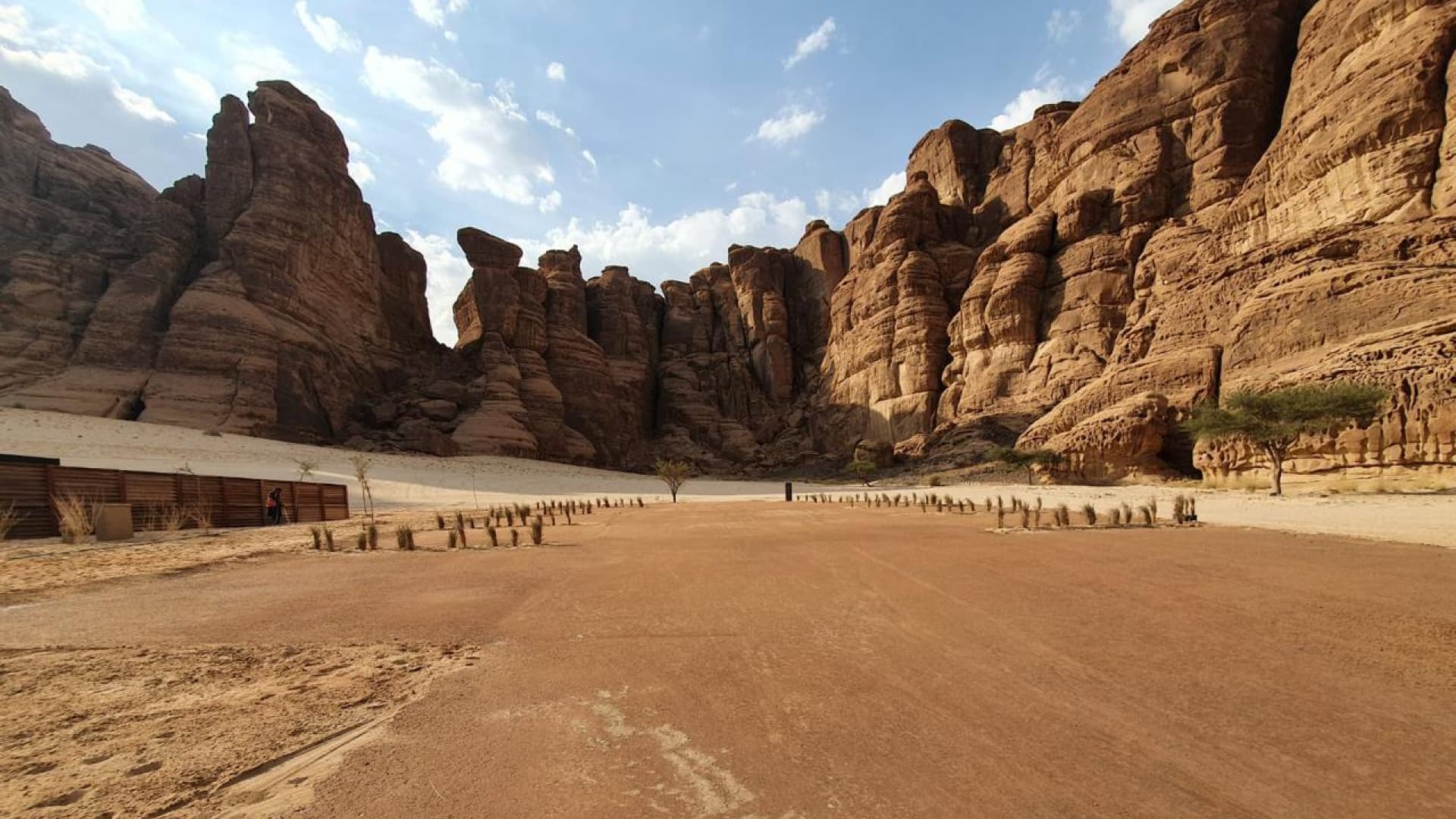
Tathbeet used T-70 polymer technology on an AlUla road-construction project in 2022. The treatment improved the road surface CBR by 340 percent, strengthening the subgrade and creating a surface designed to resist pneumatic tyre traffic.
The value of the result is not only the percentage. It demonstrates how a weak local material can become a stronger road layer when the treatment is engineered around the site.
View the AlUla Road Construction project
Access-Road Planning Checklist
- Confirm temporary or permanent use
- Identify the heaviest vehicles and expected traffic
- Test the soil along the complete route
- Establish the design CBR and required layer performance
- Design the crown, shoulders, ditches, and crossings
- Compare local soil, imported aggregate, geosynthetics, cement, and polymer
- Include dust and moving-sand control
- Define compaction and quality-control requirements
- Protect the road during curing
- Compare lifecycle maintenance, not only upfront price
- Document inspection and handover requirements
Frequently Asked Questions
What is the best material for an unpaved access road in Saudi Arabia?
There is no universal best material. The answer depends on soil type, vehicle loads, traffic, water exposure, service life, and local material availability. Testing should come before material selection.
Can desert sand be used to build an access road?
Loose desert sand normally lacks the cohesion needed for heavy traffic. It may be improved through engineered stabilization, blended with other materials, or replaced in critical layers. The correct approach depends on laboratory and field testing.
Is polymer stabilization suitable for heavy trucks?
Yes, when the polymer, dosage, treatment depth, compaction, and curing are designed for the expected loads. Tathbeet’s T-70 is intended for traffic-bearing soil stabilization, but every road still requires a site-specific specification.
Does polymer stabilization remove the need for drainage?
No. Drainage remains essential. A stabilized road can still experience erosion, ponding, or subgrade weakening if water is trapped by poor road shape or blocked drainage.
Is an unpaved access road cheaper than asphalt?
It usually has a lower initial construction cost, but the real answer depends on maintenance, traffic, imported material, water spraying, grading, and required lifespan. Compare whole-life cost rather than the opening-day price.
Build Reliable Access From Day One
Your access road controls how people, equipment, and materials move through the project. If it fails, the entire site slows down.
Tathbeet assesses the soil, loads, environment, and required service life before recommending a stabilization approach. Whether the project needs a heavy-duty T-70 road, T-30 dust and erosion control, or a combined solution, the goal is the same: dependable access built for Saudi conditions.
Discuss your access-road requirements with Tathbeet: tathbeet.net · +966 13 847 5550